


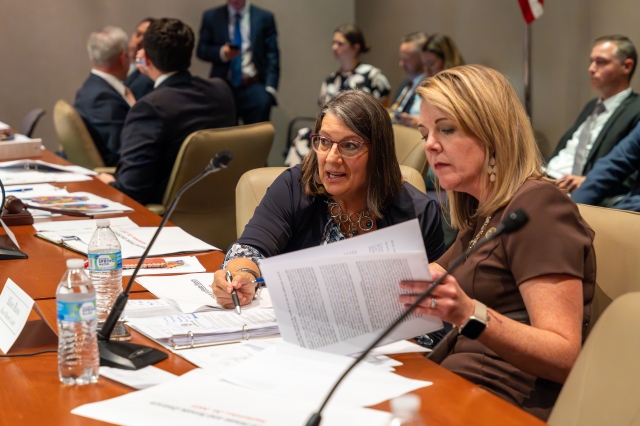

Democrats presented a proposal that would result in a 7-8 split of the state’s 15 U.S. House seats, with seven for their party and eight for Republicans.

Republicans voiced their disapproval of the Democratic plan but did not offer an alternative map or any specific details of their own.
“It is insulting to the people of Ohio that they have not come up with a proposal,” said House Minority Leader Dani Isaacsohn, a Cincinnati Democrat. “Clearly, they have opinions because they asked very specific questions.”

GOP leaders stated that they would not meet the initial constitutional deadline of September 30 to pass a bipartisan map.
With no legislative sessions scheduled to vote on a map, the task will effectively fall to the seven-member Ohio Redistricting Commission, which is controlled by the GOP.

“That doesn’t mean we’re not going to continue to work, talk, listen to Ohioans, work with the Democratic Party,” said Clermont County Rep. Adam Bird, the committee co-chair. “We want to work with everyone.”
Democrats argue that a new map should be based on the state’s voting patterns in statewide elections over the past decade, which show an average of 55% Republican and 45% Democrat support.

Republicans contested this reasoning.
“In the relevant time period in which we are to consider partisan races, Republicans have won 22 out of the 23 races,” said Stark County Sen. Jane Timken, a Republican and co-chair of the redistricting committee. “I question their logic as to why it has to be 55–45 when clearly the voters of Ohio have strongly supported Republicans over the last decade.”
Neither Timken nor other GOP members specified what they believe the partisan split should be.
Republicans currently hold 10 of Ohio’s 15 congressional seats. However, Sen. Bill DeMora, a Columbus Democrat, noted that the current map was originally drawn by GOP leaders with the goal of a 12-3 advantage.
DeMora referred to Monday’s meeting as a “dog and pony show,” suggesting that Republicans have a map prepared but are waiting to reveal it until the constitution allows them to pass it without Democratic support.
State law gives the Ohio Redistricting Commission until October 31 to pass a bipartisan map. If they fail, the GOP supermajorities can pass a map with single-party support in November.
“The whole scheme is to keep delaying and delaying and delaying,” DeMora said.
The new districts in Ohio will have national implications, as they could influence which party controls the U.S. House after the 2026 midterm elections. Republicans currently hold a narrow majority in the chamber.
Isaacsohn claimed that the effects of the current map are already being felt. He argued that the map gave Republicans the advantage they needed to pass the One Big Beautiful Bill Act, a spending bill he opposed.
“The only reason it passed is because Ohio has gerrymandered maps,” Issacsohn said. “If we had fair maps in this state that accurately represented the people of Ohio, that big ugly bill does not pass.”
Redistricting has become a point of contention across the nation, with both Republican and Democratic-led states redrawing maps outside of the traditional once-a-decade schedule.
While national Republican figures may be monitoring the situation, Timken and Bird stated they have not had communication with either President Trump or Vice President JD Vance.
A second redistricting hearing is expected to be held sometime next week.