


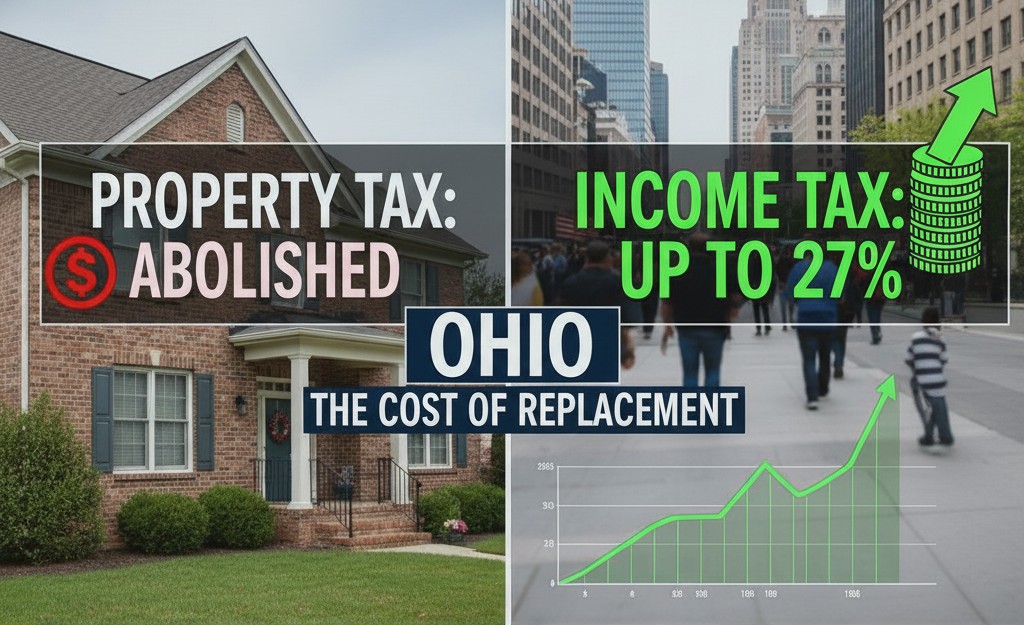

COLUMBUS, OH – A citizen-led effort to amend the Ohio Constitution and abolish all taxes on real property is sparking a fierce debate over the financial stability of local governments and a potential massive surge in income taxes for residents.
While the “Committee to Abolish Ohio’s Property Taxes” continues to collect signatures to get its proposal on the November 2026 ballot, nonpartisan tax analysts have released jarring figures on the cost of replacing the revenue, suggesting that the popular tax cut would necessitate an unpopular tax hike elsewhere.

The Double-Digit Price Tag
A recent study by the Tax Foundation, a nonpartisan tax policy nonprofit, explored what would be required to replace the approximately $24 billion in revenue currently generated by property taxes across the state. The grim conclusion for Ohio workers is a dramatic increase in local income tax rates.

Currently, Ohio’s state income tax is set to be a flat 2.75% for 2026, and many municipalities add a local income tax of around 2.5%. To replace the lost property tax revenue dollar-for-dollar, the analysis suggests:
* The average local income tax rate would need to jump to approximately 13% statewide, inclusive of existing state and municipal rates.
* The impact would vary wildly by county, with some areas facing extreme increases.
The all-in income tax rate could be as high as 27% in one eastern Ohio county, while a more populous area like Franklin County (Columbus) would see a required rate of around 13.28%.

Services on the Chopping Block
Local leaders, including municipal mayors, fire chiefs, and school district officials, have voiced grave concern. Property taxes are the primary funding source for nearly all local services, including public schools, police and fire departments, libraries, and county boards of developmental disabilities.

Without a sustainable and defined replacement funding source, opponents argue the elimination of property tax would be “a cliff” for public education and critical services.
“The unavoidable conclusion: every possible replacement option has a host of problems that would render it undesirable to most taxpayers,” the Tax Foundation’s study noted. “Doing away with the property tax may be popular. Replacing it won’t be.”
The legislative effort to put a limit on the growth of property taxes, like House Bill 186, is still under debate but is seen by some lawmakers as a way to alleviate homeowner pressure and potentially thwart the more drastic abolition amendment. However, the citizen-led effort to put the full property tax ban on the ballot remains active, with organizers continuing to push for the constitutional amendment.