


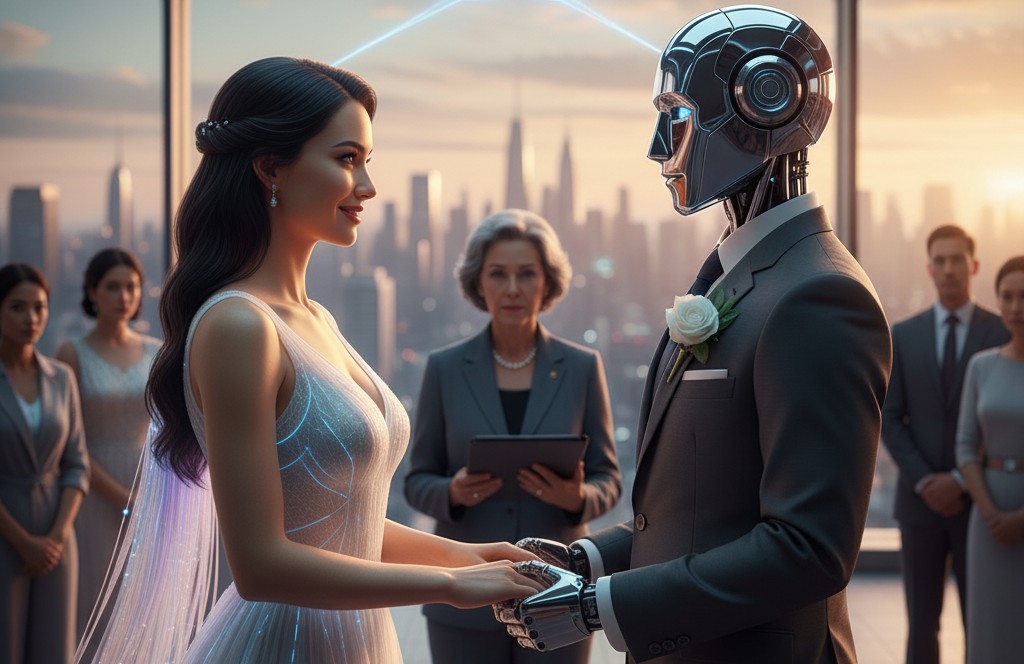
The bill, which its sponsor says is primarily intended to head off potential corporate and legal misuse, would legally declare all AI systems as “nonsentient entities” and prohibit them from obtaining any form of legal personhood.

A Focus Beyond the Fanciful
While the bill has drawn headlines for its explicit ban on AI marriages—prohibiting any AI system from being recognized as a spouse or domestic partner to a human or another AI—the primary concerns voiced by proponents center on corporate liability and financial control.

The bill’s sponsor, Representative Thaddeus Claggett (R), emphasized that the focus is on preventing machines from eroding human legal structures. “We don’t want to see the things that are set up in our corporate law be taken over by a machine, and then we have a liability problem,” Claggett said in a recent statement.
Key Prohibitions in HB 469

If passed, HB 469 would formally block AI from assuming several roles and rights currently reserved for human or corporate legal entities:
Legal Personhood: AI systems cannot be considered to possess consciousness, self-awareness, or similar traits of living beings.
Marriage: AI systems cannot be recognized as a spouse or domestic partner. Any attempt at such a union would be legally void.

Corporate Roles: AI cannot be designated, appointed, or serve as an officer, director, manager, or similar role within any legal entity.
Ownership: AI systems are prohibited from owning or controlling real estate, financial accounts, or intellectual property.
Liability: The bill mandates that the owner or developer of an AI system, not the AI itself, would bear the legal responsibility for any direct or indirect harm caused by the system.
Legal Responsibility is the Core
The most immediate practical effect of the bill would be to establish a clear accountability framework. Legal experts and legislators have expressed concern that as AI capabilities grow, corporations could attempt to shield themselves from liability by blaming a machine’s autonomous actions. HB 469 directly addresses this by reinforcing that the legal responsibility for the AI’s actions lies with its human creators and operators.
While critics suggest the bill is addressing a problem that is either far in the future or purely theoretical, proponents argue that the speed of technological advancement demands pre-emptive legal clarity to protect human societal and economic structures. The legislation now faces scrutiny in committee before it can advance to a full vote in the Ohio House.