


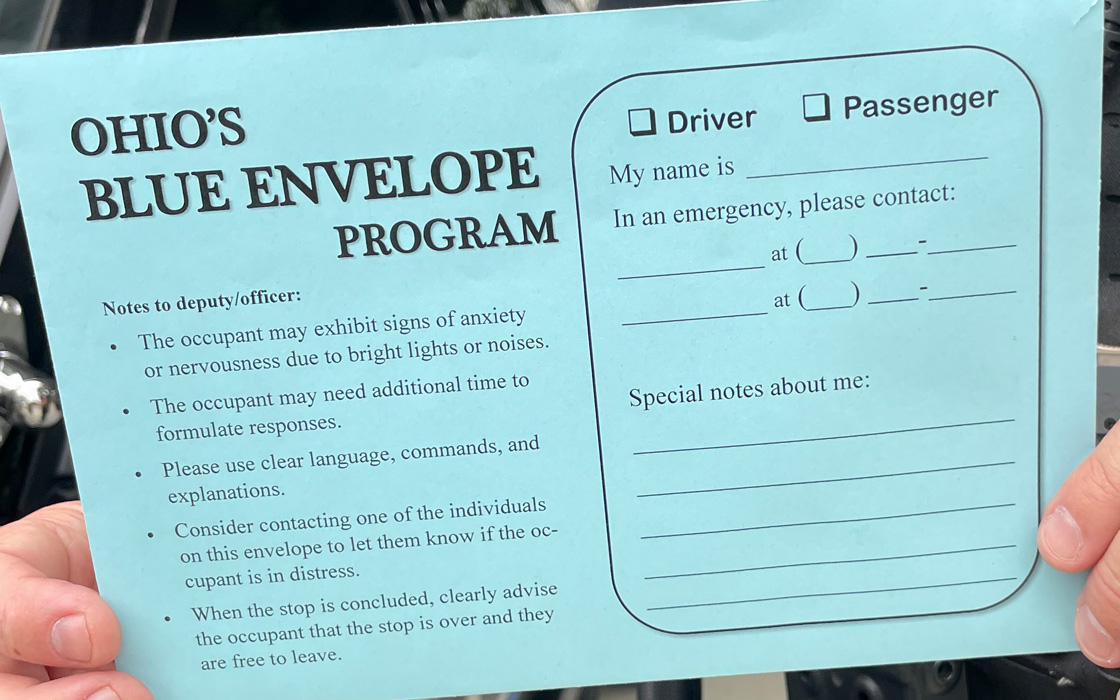
The Blue Envelope Program, launched through a collaboration among the Ohio Department of Public Safety, the Governor’s Council on Developmental Disabilities, and several law enforcement agencies, marks the latest effort to reform police interactions with vulnerable populations.

A Tool for Understanding — or Another Layer of Risk?
Inside the distinctive blue envelope, individuals can store important documents such as driver’s licenses, vehicle registrations, and contact cards explaining communication preferences or special needs. The envelope’s exterior carries printed instructions for both the driver and the officer — guidance intended to de-escalate potential misunderstandings.

“The purpose is to create a moment of recognition,” said Lt. Col. Scott Wyckoff of the Ohio State Highway Patrol, who helped oversee the pilot program earlier this year. “When an officer sees that blue envelope, they know to slow down, speak calmly, and check for communication sensitivities or processing delays.”
Yet some disability advocates caution that the program, while well-intentioned, is not a guarantee of safety. “A colored envelope doesn’t replace proper police training,” said Lisa York, an advocate with Disability Rights Ohio. “We support any effort that promotes understanding, but there must be accountability to ensure all officers know what the envelope means.”

Program Roots in Tragedy and Advocacy
The initiative follows similar programs launched in Connecticut, Texas, and New Jersey in recent years, most created after high-profile incidents in which individuals with autism or mental health conditions were harmed or killed during police encounters. In many cases, officers misinterpreted behaviors — such as lack of eye contact, delayed responses, or repetitive movements — as signs of defiance or intoxication.

According to state data, Ohio law enforcement responds to thousands of calls annually involving individuals with cognitive or developmental disabilities, a fact that spurred growing demands for specialized training and communication tools.
“This program was born from conversations with families who were terrified about what could happen to their loved ones during a routine stop,” said Derry Yost, chair of the Ohio Developmental Disabilities Council. “We hope this envelope becomes a bridge, not just a symbol.”
Implementation and Accessibility Concerns
Blue Envelope packets are now available through county boards of developmental disabilities, Bureau of Motor Vehicles offices, and participating advocacy organizations. But early implementation has revealed uneven distribution across regions. Some rural counties reported receiving only small initial shipments, while urban centers such as Cleveland and Columbus began rolling out hundreds of packets this week.
Critics say accessibility issues could undermine the program’s reach. “If you live in a smaller county or don’t drive, you may never hear about this resource,” said York. “The state must ensure consistent outreach, especially in underserved areas.”
Police training is another key concern. The Ohio Peace Officer Training Academy (OPOTA) confirmed that a short module on the program has been added to ongoing continuing education sessions, but many local departments are still crafting their own rollouts. Several officers interviewed for this story said they had not yet received detailed guidance.
Balancing Awareness and Privacy
Some advocates have expressed unease about potential privacy implications. Carrying a blue envelope could unintentionally signal a medical diagnosis or cognitive condition to others.
“People have a right to disclose their disability on their own terms,” said Dr. Henry Thompson, a mental health researcher at Case Western Reserve University. “While the envelope can be empowering, it could also make individuals vulnerable to stigma or misunderstanding if misused.”
State officials counter that participation is entirely voluntary and stress that the envelopes carry only limited personal information — no official medical data or agency documentation.
The Human Impact
For families like the Raines of Akron, whose 22-year-old son Jacob lives with autism, the envelope represents hope for safer interactions.
“Jacob freezes when faced with authority figures,” said his mother, Kelly Raines. “He doesn’t always respond right away, and that’s been scary. If this blue envelope helps even one officer realize he’s not being defiant — just processing — it’s worth it.”
Advocates say the success of the Blue Envelope Program will depend not only on how widely it’s distributed but also on how seriously officers take its intent.
“The envelope is just a tool,” York said. “The real change comes from empathy, training, and accountability.”
Looking Ahead
Ohio’s Department of Public Safety plans to assess the program mid-2026, gathering feedback from both the public and law enforcement. Disability rights groups are pushing for independent evaluation to track whether the initiative reduces incidents of escalated encounters.
For now, the Blue Envelope stands as a small but significant gesture — one designed to turn a moment of potential fear into one of understanding. Whether it succeeds could depend on how faithfully Ohio’s police departments embrace its spirit, not just its optics.