


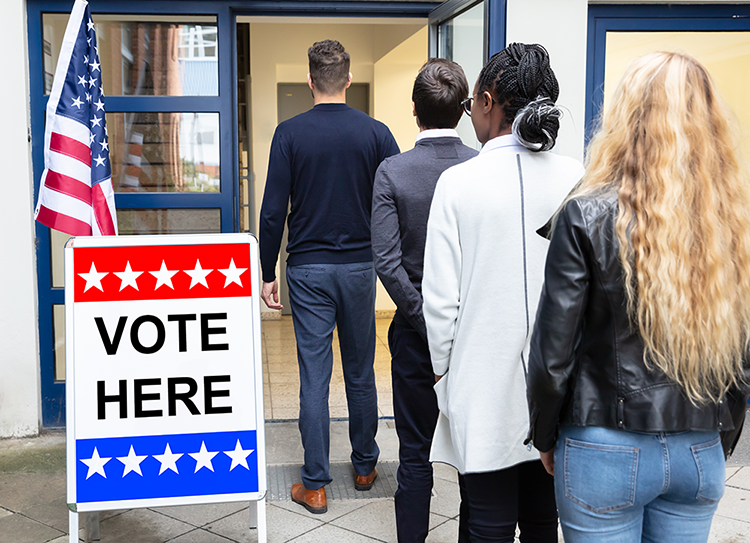
On the surface, the Seneca County dispute involved a First Amendment question—whether an individual could be barred from election work solely based on their distrust of voting machines. However, for the GOP hopefuls present, the issue was fundamentally political: how to appeal to a growing base of voters who question election integrity without fully endorsing a dramatic and unfeasible return to hand counting.

The Tightrope for Ohio Republicans
President Trump’s stated preference is to ban most mail-in ballots and eliminate all electronic voting machines in favor of hand-counted, paper-only elections. This presents a major challenge for Ohio Republicans, who have long boasted that the state’s current system is a “national model” for election security and efficiency.

The central question for the party is not whether to act, but how far to go: fully embrace the hardline demands, adopt a more cautious middle path, or defend the current structure. David Pepper, a former Ohio Democratic Party Chair and election law professor, called the proposed changes nonsensical, arguing that to “dramatically change things based on what a president is saying based on unproven allegations of fraud makes no sense.”
The Future of Mail-In Voting

Absentee voting is a key flashpoint. Around 1 million Ohioans voted absentee in 2024. Trump recently stated on Truth Social that he wants to eliminate all mail-in voting except for the “very ill, and the far away military.”
Some influential Ohio Republicans are receptive to limiting the practice. House Speaker Matt Huffman stated, “If you can avoid doing mail-in balloting, don’t do it,” citing ways the process can be “messed up.” Treasurer Robert Sprague, a candidate for Secretary of State, echoed this concern, saying he finds it “difficult… to reconcile trusting the United States Postal Service with half of our votes.”

Ohio’s current absentee voting law allows any registered voter to request a ballot—a measure passed after the 2004 election embarrassment where Ohioans endured marathon lines, some standing for up to 10 hours in the rain. Prior to 2020, Republicans were just as likely to vote by mail, but Trump’s repeated attacks on the practice have since shifted the view of many GOP voters and officials. Jen Miller, executive director of the League of Women Voters of Ohio, warned that new limits would disproportionately impact older adults and rural residents, emphasizing that the current system is secure, requiring voters to prove their identity twice.
Hand Counting vs. Machines: A Question of Scale
Ohio’s current system ensures every ballot leaves a paper trail, whether by paper ballot or a touchscreen-printed receipt, but all votes are ultimately counted by machine. Trump has voiced repeated opposition to electronic counting.
Marcell Strbich, who is challenging Sprague for Secretary of State, has made giving counties the option to hand count a cornerstone of his campaign, citing “local sovereignty” and alignment with Trump’s direction.
In contrast, GOP gubernatorial candidate Vivek Ramaswamy struck a cautious tone, saying there’s “room for reasonable discussion” on the issue. Sprague, while a longtime supporter of paper ballots, deferred to the former President on the counting method, saying he would be interested to see Trump’s opinion, given his access to information about “enemies abroad.” Democrat Allison Russo, also running for Secretary of State, defended the current system, pointing out that machines are regularly tested and audited.
The impracticality of a full hand count is a major barrier. A mock hand count conducted in Butler County using 2020 election data showed that two-person teams took nearly 2.5 hours to count batches of 50 ballots. At this rate, the largest precincts could take more than 50 hours to complete, with an observed error rate of one mistake per batch. Despite the challenges, a growing movement, exemplified by a recent Seneca County petition to eliminate machine counting, shows that conservative distrust is spreading.
Ultimately, Ohio Republicans are prioritizing areas where they already align with Trump, such as strict voter ID laws and requiring proof of citizenship during voter registration, as they navigate the pressure to dismantle a system they once called “the gold standard for election administration.”