


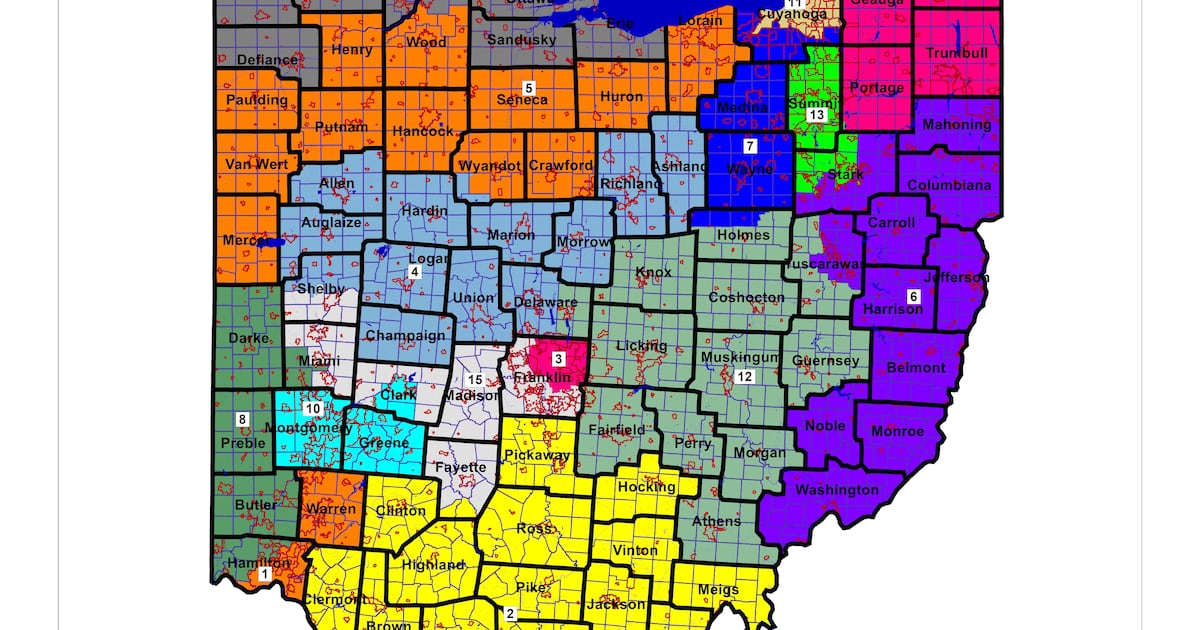
Key Map Changes

The new map tilts two districts currently held by Democrats—Cincinnati’s 1st and Toledo’s 9th—further to the right, presenting tougher challenges for Representatives Greg Landsman and Marcy Kaptur. Meanwhile, the Akron-based 13th District, currently held by Emilia Sykes, would become slightly more favorable for Democrats. Overall, Republicans currently hold 10 of Ohio’s 15 congressional seats; under the new lines, projections suggest the GOP could secure as many as 12 seats, leaving three for Democrats.
Political Implications

The proposed map represents a bipartisan compromise—Democrats reportedly chose to accept the new lines, fearing that a legislative impasse would shift redistricting authority entirely to the Republican-controlled state legislature, which could pursue more aggressive gerrymandering. Additionally, because the map was introduced and potentially approved by the commission, it bypasses a statewide referendum option that could otherwise have kept the current map in place until 2026. This deal comes just ahead of a Friday legal deadline that would otherwise have changed the approval process and political risks for both parties.
Community and Advocacy Response

Public reaction has been contentious, with critics highlighting concerns about increased county splits, municipal divisions, and the impact on communities of interest. Advocacy groups like the League of Women Voters of Ohio have argued that the map does not represent voter registrations and prioritizes political advantage over fairness.
National Context

Ohio’s redistricting drama plays out amid a broader national wave, with states like Texas, Missouri, and North Carolina also moving to redraw congressional maps to strengthen GOP representation following encouragement from former President Donald Trump. Meanwhile, Democrats in California and Virginia are pursuing their own mid-decade redistricting efforts, as both parties seek every possible advantage before the 2026 midterm elections.
The Ohio Redistricting Commission’s proposal is poised to shape not only the state’s congressional delegation, but also the balance of power in Congress for years to come.