


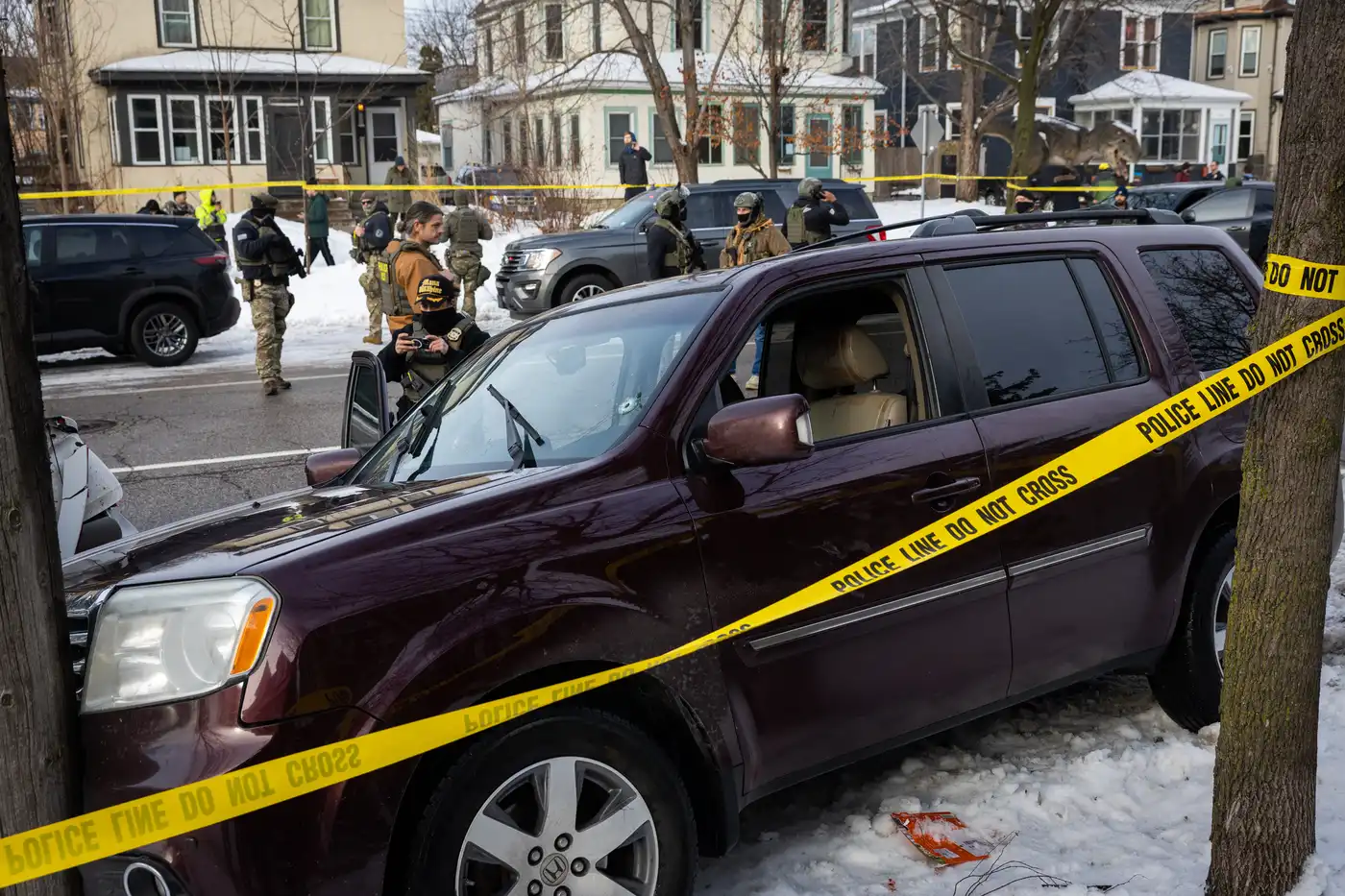
Federal vs. Local Accounts

Federal officials, including Homeland Security Secretary Kristi Noem and Vice President JD Vance, defended the shooting as self-defense against a driver ramming officers, with Vance calling it an attack on law enforcement. Video footage shows Good’s maroon Honda Pilot halting, agents approaching, and the vehicle reversing slightly before moving forward toward one agent, prompting three shots. Local leaders, including Governor Tim Walz, argue the agent’s approach created jeopardy, and Mayor Frey dismissed self-defense claims as “bullshit,” vowing to seek justice.
Vehicle-as-Weapon Precedents

Police shootings of motorists often invoke the “vehicle as weapon” justification, but a 2021 New York Times analysis found many cases involve evasion rather than assault. Major cities like New York and Los Angeles ban firing at moving vehicles unless occupants shoot or pose crowd threats; DHS’s 2018 policy similarly restricts it absent deadly force justification. Justice Department guidelines urge avoiding shots at vehicles by stepping aside when possible.
Legal and Ethical Questions

In scenarios where a driver obstructs justice by targeting officers with a vehicle, use-of-force depends on perceived imminent threat under Graham v. Connor standards. If an officer reasonably fears death or injury from a vehicle accelerating toward them, deadly force is often upheld, as in cases where suspects ram barricades or flee aggressively. Departments train to prioritize de-escalation, but courts frequently side with officers facing direct vehicular assaults.
Hypothetical: Officer in Peril

Yes, an officer could lawfully open fire on a driver using their vehicle as a weapon against them, such as accelerating to run them over while obstructing justice, provided the threat is immediate and no safe retreat exists. This mirrors federal defenses in the ICE case, where Ross fired after Good’s SUV moved toward him. Outcomes hinge on body cam footage, witness accounts, and policy compliance, balancing officer safety with avoiding unnecessary escalation.
Comparing Ohio Cases to ICE Shooting
Ohio has seen multiple incidents where vehicles were used as deadly weapons against officers or deputies without firearms involved, prompting officers to use deadly force in self-defense when fearing imminent harm.
Confirmed Vehicle-Only Cases
In Ohio, cases like the Ta’Kiya Young shooting in 2023 (Blendon Township) involved an unarmed pregnant woman accelerating her vehicle toward a deputy during a shoplifting stop, leading to deadly force when the officer perceived no safe escape—mirroring pure vehicular threat dynamics without guns. Another 2025 case saw a deputy shoot after a suspect’s car rammed toward him during a traffic stop, with bodycam showing acceleration as the sole weapon, justified under imminent peril standards.
Legal Precedents
These align with Graham v. Connor, where courts uphold officer shootings if a vehicle poses deadly risk—like closing distance rapidly—absent other arms, as long as retreat isn’t viable. Ohio BCI reviews often clear such actions when footage confirms the threat, similar to ICE’s Minnesota probe.
Ties to ICE Shooting
The Minneapolis incident fits precisely: no gun on Renee Good, just her SUV edging forward toward agent Ross, treated as a weaponized threat justifying three shots. Ohio’s vehicle-ramming precedents reinforce that deadly force applies uniformly when officers face direct vehicular assault, regardless of local or federal role.