


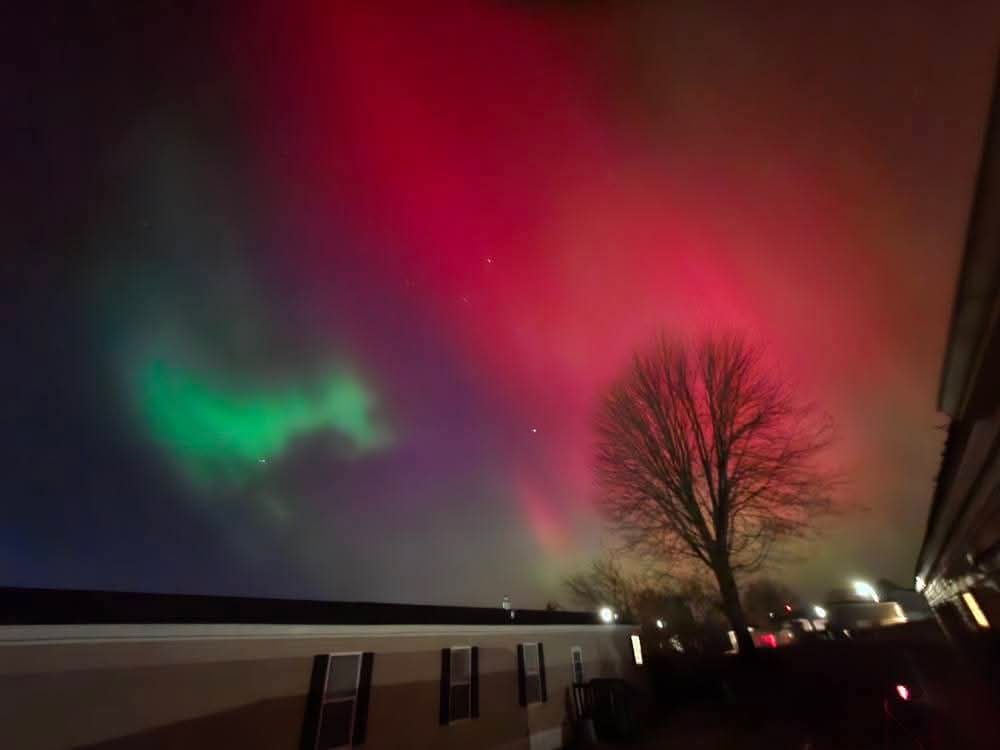
The National Oceanic and Atmospheric Administration (NOAA) has maintained a high-level G4 (Severe) Geomagnetic Storm Watch for tonight, following a series of potent solar flares and Coronal Mass Ejections (CMEs) that have slammed into Earth’s magnetic field. This solar activity has already resulted in dazzling displays across northern states and even into typically aurora-free zones.

The Science Behind the Sky’s Light Show
The Northern Lights, or Aurora Borealis, are not just a magical occurrence; they are a dramatic, beautiful consequence of a cosmic dust-up between the Sun and Earth.

* The Solar Wind: The Sun is a constant nuclear furnace, continuously blasting a stream of electrically charged particles—mostly electrons and protons—into space. This is known as the solar wind.
* Earth’s Magnetic Shield: Fortunately, Earth has a strong, invisible magnetic field that acts like a gigantic, protective shield, deflecting most of these particles.
* The Collision: However, during a powerful event like a solar flare or a Coronal Mass Ejection (CME), the sheer force of the incoming particles overpowers the magnetic field, particularly at the planet’s poles. The charged particles are then funneled down along the magnetic field lines toward the North and South Poles.
* The Glow: As these high-speed particles collide with atoms and molecules of gases in Earth’s upper atmosphere (like Oxygen and Nitrogen), they “excite” them. When these excited atoms return to their normal state, they release energy in the form of photons—light!
* Green: The most common color, produced by collisions with oxygen at lower altitudes.
* Red: Produced by oxygen at higher, more rare altitudes.
* Blue/Purple: Produced by nitrogen molecules.
The intensity of tonight’s storm means a higher volume of charged particles are making it into the atmosphere, which is why the light show is expected to be visible much further south than usual.

Where and When to Watch
* Peak Activity: The most brilliant and expansive displays are anticipated in the late evening, particularly between 10:00 p.m. and 1:00 a.m. local time, when the G4 storm levels are expected to peak.
* Widespread Visibility: According to NOAA’s forecast models, the aurora borealis could be visible across the northern half of the continental U.S., potentially reaching as far south as states like Alabama and northern California. Regions in the Midwest and Northeast that rarely see the lights have a strong chance tonight, assuming skies are clear.
* The Best View: Your chances drastically increase if you can get away from city light pollution and find a spot with a clear, unobstructed view of the northern horizon.

Pro Tip for Aurora Hunting: Don’t rely solely on your naked eye! Camera sensors are often more sensitive to the faint colors of the aurora. Try a long-exposure shot toward the north—your phone or camera might capture the lights even if they appear as a subtle glow to you.
The Bottom Line: Tonight is a rare opportunity to catch one of nature’s most dramatic performances. If you’re willing to brave the chill and stay up late, the sky is giving us a spectacular reason to look away from our screens.